

Salesforce Alternatives: What to Consider
What to consider when evaluating Salesforce alternatives, including no code platforms and lighter weight CRM options.
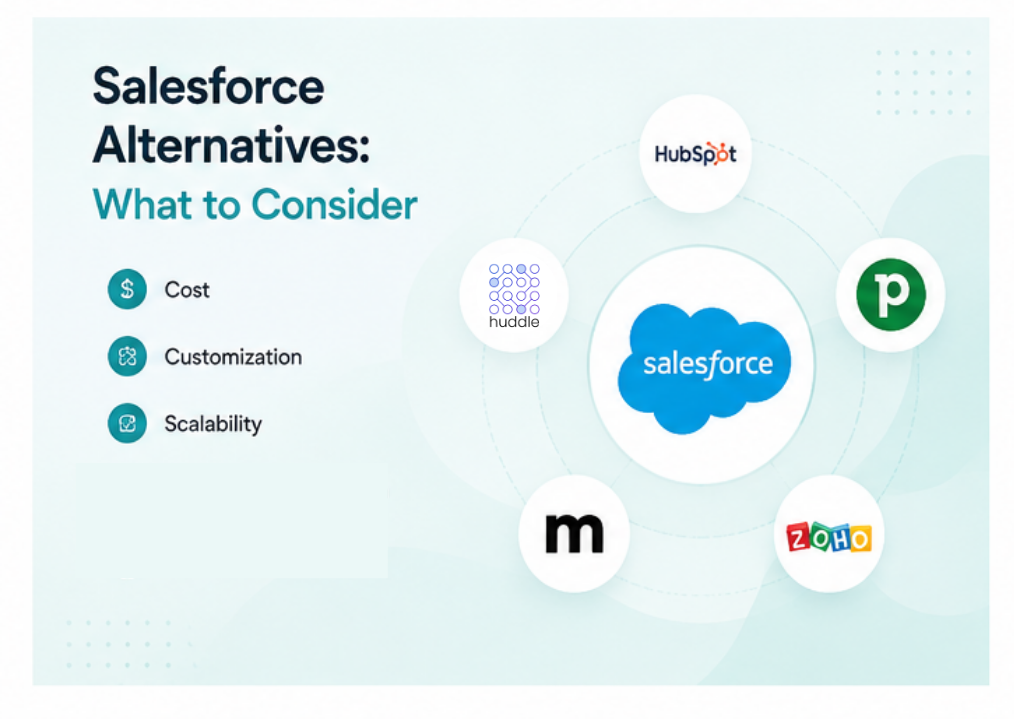
Salesforce is the dominant CRM platform and has been for more than two decades. It is also priced and architected for enterprise organizations. In 2026, Salesforce Sales Cloud Pro Suite costs $100 per user per month, billed annually. For a 10 person team, that is $12,000 per year in licenses before implementation, customization, integrations, or the admin resources needed to maintain it. For many small and mid sized businesses, the cost to value equation doesn't hold, and the alternatives have improved significantly. This article covers the most practical Salesforce alternatives in 2026 and how to evaluate which one fits.
What Salesforce Actually Costs in 2026
Salesforce's pricing is structured around multiple "clouds" (Sales Cloud, Service Cloud, Marketing Cloud, etc.), each priced separately. The Starter Suite entry plan is $25 per user per month, which covers basic contact management and pipeline tracking. The Pro Suite, which is where most meaningful functionality becomes available, is $100 per user per month as of April 2026.
For context, a 10 person sales team on Pro Suite pays $12,000 per year in licenses alone. Add implementation (typically $10,000 to $500,000 depending on scope), an admin resource or consultant to manage the system, and add ons for Marketing Cloud, inbox, and analytics, and the real first year cost for a small business can run $40,000 to $60,000 or higher.
Implementation timelines range from 4 to 8 weeks for a minimal setup to 4 to 6 months for a more complex deployment involving data migration and custom workflows.
When Salesforce Is Worth It
Salesforce justifies its cost when a business has complex, high volume sales processes with deep customization needs, integration requirements across multiple enterprise systems, and the internal resources (a dedicated admin or a Salesforce certified consultant) to configure and maintain the platform. For organizations at that scale and complexity, Salesforce's AppExchange ecosystem, reporting depth, and workflow automation capabilities are genuinely difficult to match.
If the sales process is relatively straightforward, the team is under 100 people, or the budget for a dedicated CRM admin is not available, Salesforce is likely more than is needed.
Salesforce Alternatives by Use Case
HubSpot CRM
HubSpot is the most commonly cited alternative to Salesforce for small and mid sized businesses. It offers a free CRM tier with contact management, pipeline tracking, and email tools with no user limit, making it a natural starting point for teams that want to get something in place before committing to paid CRM spend.
Paid HubSpot plans bring in additional hubs for marketing, customer service, and operations. The Starter tier begins at $20 per user per month. Enterprise tiers can reach $100 to $150 per user per month, though most SMBs operate well below that level.
The key advantage over Salesforce is that HubSpot is significantly easier to set up and maintain without a dedicated admin. Implementations typically take days to weeks rather than months. HubSpot's AI features (Breeze AI) are available to paid users across tiers and cover lead scoring, email generation, and deal summaries without additional per user fees.
Best for: SMBs that want a full featured CRM without dedicated admin resources, teams moving from spreadsheets to a structured CRM for the first time, and businesses that want to start free and grow into paid features.
Zoho CRM
Zoho CRM offers a broad feature set at a significantly lower per user price than Salesforce. Plans start at $14 per user per month (Standard) and scale through Professional ($23) and Enterprise ($40). A free tier supports up to 3 users.
Zoho covers the core CRM workflow (pipeline management, lead scoring, email sequences, automation, and forecasting) and integrates with the broader Zoho ecosystem (Zoho Desk, Zoho Projects, Zoho Books) for businesses that want a unified stack. The interface is less polished than Salesforce or HubSpot but the functionality to price ratio is strong for teams that prioritize value over design.
Best for: Budget conscious teams that want a feature complete CRM at significantly lower cost than Salesforce, and businesses already using other Zoho products.
Pipedrive
Pipedrive is a sales focused CRM built around pipeline management. It is designed for sales teams rather than marketing or customer service, which makes it a more focused and faster to learn tool than Salesforce's broader platform. Plans start at around $24 per user per month.
Best for: Small sales teams that want a clean, visual pipeline tool without the complexity of a multi cloud CRM platform.
Freshsales
Freshsales combines CRM with built in phone and email, allowing sales teams to communicate with prospects directly from the CRM without separate tools. Its Growth plan starts at $11 per user per month. AI powered lead scoring is included on paid tiers.
Best for: SMBs that want CRM and communication tools in one place at an accessible price, particularly teams that do a lot of outbound calling or emailing.
Microsoft Dynamics 365
Microsoft Dynamics 365 is the other major enterprise CRM option alongside Salesforce. Its Customer Service Professional plan starts at $50 per user per month, significantly lower than comparable Salesforce tiers. For organizations already running on Microsoft 365, Teams, and Azure, the native integration makes Dynamics a compelling alternative to Salesforce without requiring a separate ecosystem.
Best for: Organizations already embedded in the Microsoft ecosystem that need enterprise grade CRM with native Microsoft integrations.
What About Teams That Need Data Connectivity More Than CRM
One common situation that doesn't fit neatly into the CRM alternatives list is teams that don't primarily need a CRM, they need a way to surface, visualize, or interact with the customer data they already have in Salesforce, HubSpot, or a spreadsheet, through a cleaner interface that their team can actually use.
For these teams, the choice isn't about replacing Salesforce with another CRM. It's about building a portal or dashboard on top of existing data without migrating it. A no code tool that connects directly to Salesforce, HubSpot, or other data sources, without duplicating data, can give teams the view they need without replacing the system of record they already rely on.
See No Code and Enterprise Software Alternatives: A Buyer's Guide for more on this approach. For a detailed look at Salesforce pricing, see the No Code App Builder and Enterprise Software Pricing Guide and the Salesforce pricing breakdown.
Side by Side Comparison
| Platform | Starting Price | Free Tier | Implementation Time | Best For |
|---|---|---|---|---|
| Salesforce | $25/user/month (Starter), $100/user/month (Pro) | Limited (2 users) | 4 weeks to 6 months | Enterprise with complex workflows |
| HubSpot | Free, paid from $20/user/month | Yes, unlimited users | Days to weeks | SMBs, marketing driven teams |
| Zoho CRM | $14/user/month | Yes, up to 3 users | Days | Budget focused teams |
| Pipedrive | ~$24/user/month | No (14 day trial) | Days | Sales focused teams |
| Freshsales | $11/user/month | Yes, up to 3 users | Days | Teams wanting CRM with built in communication |
| Microsoft Dynamics 365 | ~$50/user/month | No | Weeks to months | Microsoft ecosystem organizations |
Frequently Asked Questions
Related Topics
Build Your Internal Tools With Huddle
Huddle is a zero code application builder that connects to Google Sheets, Airtable, Excel 365, HubSpot, and Salesforce without requiring data migration. Build dashboards, forms, and portals with drag and drop widgets and publish to a shareable link in minutes.
Start building with Huddle