What Is Vibe Coding and How It Compares to No Code
A plain English explanation of vibe coding, what it actually means, and how it differs from no code app builders.
Vibe coding was coined as a term in early 2025 and named Collins Dictionary's Word of the Year by November of that year. By 2026, it had gone from a niche developer concept to something operations managers, startup founders, and IT leads are actively asking about. This article explains what it actually is, how it differs from no code tools, and which approach makes more sense depending on what a team is trying to build.
What Is Vibe Coding
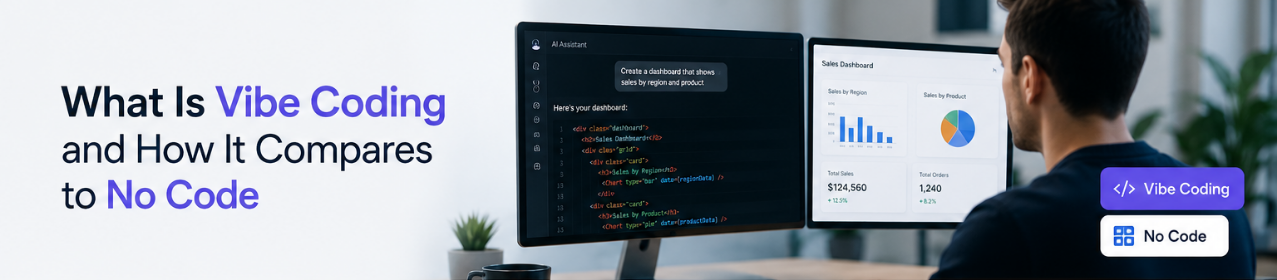
Vibe coding is a software development practice where a person describes what they want to build in plain language, and an AI tool generates the code for them. Instead of writing syntax line by line, the developer or builder focuses on describing the outcome, iterates through prompts, and lets the AI handle the implementation.
The term was coined by AI researcher Andrej Karpathy in February 2025, who described it as "a new kind of coding where you fully give into the vibes." The idea spread quickly because the timing matched a broader shift in what AI models could produce. By early 2025, tools like Claude, GPT-4o, and Gemini could generate entire working applications from a single detailed prompt.
The key distinction of vibe coding is that practitioners accept AI-generated code without fully reviewing every line, relying on prompts and iteration rather than direct code editing. The output is real code, running on real infrastructure, but the person building it may never read or fully understand what was generated.
How Vibe Coding Works in Practice
The general workflow looks like this:
- A person opens a vibe coding tool such as Lovable, Bolt.new, Cursor, or Replit.
- They describe what they want to build in plain language: "Build a customer feedback tracker with a form for collecting ratings, comments, and categories. Show a dashboard with average rating by category and a timeline of recent submissions."
- The AI generates a working application including the interface, backend logic, and data structure.
- The person tests it, describes what to change, and the AI iterates.
- The result is deployed to a live URL.
The whole process can take minutes for a simple tool and hours for something more complex, compared to days or weeks with traditional development.
What the Data Actually Says About Vibe Coding in 2026
Vibe coding has been widely adopted but the results are more nuanced than the hype suggests.
By 2026, 92% of US developers report using AI coding tools daily, and 46% of new code is AI-generated. At the same time, trust in that code has dropped from 77% to 60% since its peak.
Security researchers found that 45% of AI-generated code samples contain OWASP Top-10 vulnerabilities. A December 2025 analysis found that AI co-authored code contained 1.7 times more major issues than human-written code.
In one assessment of five popular vibe coding tools, researchers built 15 identical apps and found 69 vulnerabilities across them, including six critical ones.
This does not mean vibe coding does not work. It means the output requires oversight, and for applications touching sensitive data or production workflows, that oversight matters.
What No Code Tools Are
No code platforms let people build applications using visual drag and drop tools, without generating or touching code at all. The platform itself handles everything behind the scenes. The person building the tool selects components, connects data, configures layouts, and publishes, all through a visual interface.
No code tools have been around longer than vibe coding and are generally more predictable in output. Since the building blocks are fixed and tested by the platform, what gets built behaves consistently. There is no underlying code to review, audit, or accidentally break.
Vibe Coding vs No Code: The Core Differences
Both approaches let people without traditional development backgrounds build working applications. But they serve different needs.
Output type. Vibe coding produces real, exportable code that runs on standard infrastructure. No code platforms produce applications that run inside the platform's environment. This affects portability and long term flexibility.
Technical floor. No code platforms are designed for zero technical background. Vibe coding works best for people who can at least evaluate whether a generated result looks correct, even if they cannot write the code themselves.
Predictability. No code tools produce consistent, predictable results since the components are pre built and tested. Vibe coding output varies between generations and often requires iteration to get right.
Security and governance. No code platforms handle security, permissions, and data storage within their own infrastructure. Vibe coded applications require the builder to manage or review security, which can be a significant gap for non-technical users.
Use case fit. Vibe coding excels at rapid prototyping, personal utilities, and proof-of-concept builds. No code tools are better suited for structured business applications that need to be reliable, shared with a team, and maintained over time without developer involvement.
Vibe Coding Tools in 2026
The AI app builder market in 2026 splits broadly into three categories: platforms that generate web apps from prompts (vibe coding tools like Lovable and Bolt.new), platforms built for enterprise internal tools (Retool, Power Apps), and traditional no code builders that have added AI features (Bubble, Softr, Glide).
The most widely used pure vibe coding tools include Lovable, Bolt.new, Cursor, Replit, and v0. Each generates code from prompts and is best suited to developers or technically literate users who can review what gets produced.
Which Approach Is Right for Business Teams
For operations, IT, and HR teams building internal portals, dashboards, or self service tools, no code is generally the more practical choice. The reasons are practical rather than philosophical.
Business teams need tools that work reliably for everyone who uses them, not just the person who built them. They need to be maintained without developer involvement when data sources change. They need to be shared with a team without worrying about what code is running underneath.
Gartner projects that 75% of new enterprise applications will be built on no code or low code platforms by the end of 2026. That projection is about governed, structured tools built for real business operations, not quick prototypes.
Vibe coding is a powerful tool for the right use case. For teams that need a reliable, maintainable, data-connected internal portal that everyone can use today, a purpose built no code platform is often the faster path to something that actually works in production.
See AI App Builders and No Code Platforms: A Complete Guide for a broader overview of the category.
Frequently Asked Questions
Related Topics
Build Your Internal Tools With Huddle
Huddle is a zero code application builder that connects to Google Sheets, Airtable, Excel 365, HubSpot, and Salesforce without requiring data migration. Build dashboards, forms, and portals with drag and drop widgets and publish to a shareable link in minutes.
Start building with Huddle